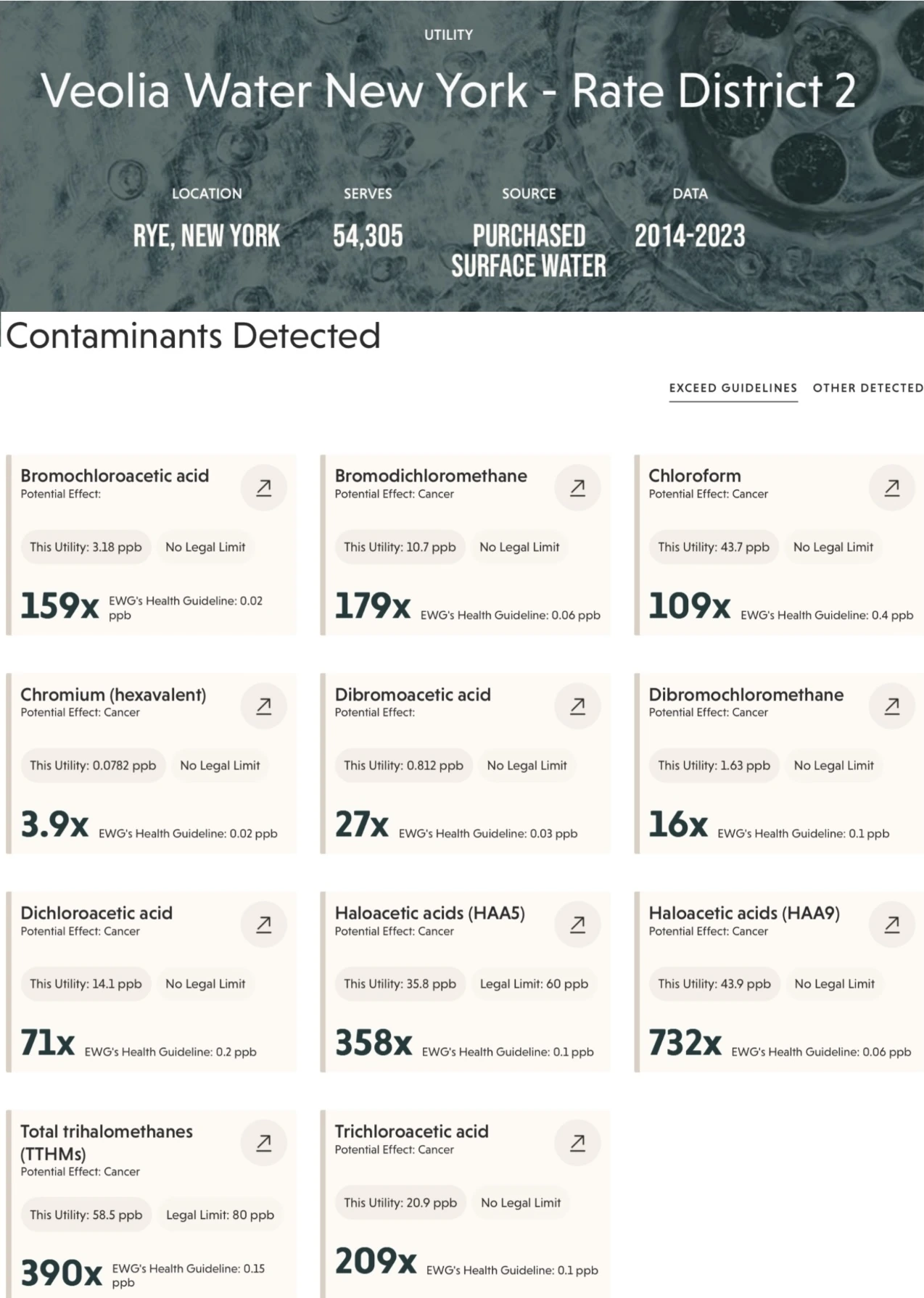
58.5 ppb
Total trihalomethanes
EWG displays this annual average against its health benchmark of 0.15 ppb. The federal maximum contaminant level is 80 ppb.
This investigation began after conversations concerning Port Chester’s ongoing water-infrastructure work and lead-service-line replacements. EWG reports 24 contaminants in the municipal supply serving approximately 54,305 customers—nearly 55,000 people—in Port Chester, Rye and the surrounding Rate District 2 service area.
Veolia Water New York – Rate District 2 · purchased surface water · utility data covering 2014–2023, with EWG’s highlighted exceedances based on 2021–2023 annual averages.
This article was prompted by discussions about current pipe replacement activity in Port Chester. The Village of Port Chester publicly announced that Con Edison and Veolia were coordinating utility upgrades and lead service line replacements, including a published July replacement schedule. That official notice confirms that lead-bearing service infrastructure is presently being removed in the Village.
What the available public record does not establish by itself is the precise number of feet being replaced, the historical lead dose received by each household, or a quantifiable claim that fifty years of disease in Port Chester was caused by drinking water. Those conclusions require property-level service-line inventories, historical sampling records, blood-lead data and epidemiologic analysis.
The defensible concern is still substantial: lead service lines can introduce lead after treated water leaves the utility’s main, exposure may vary dramatically from one building to the next, and no visual inspection of a glass of water can reveal the dose. Replacement work occurring now also raises an obvious question for long-term residents: how long were those lead-containing lines in service before removal?
Official Village of Port Chester notice: utility upgrades and lead service line replacements
“We have been drinking this water for years and we are still alive” treats chronic chemical exposure as though the only possible outcome were immediate death. That is not how most drinking-water toxicology works.
Many contaminants are evaluated because repeated exposure may incrementally increase the probability of cancer, liver or kidney injury, developmental effects, reproductive effects, thyroid disturbance or other chronic biological changes. These outcomes may develop slowly, may affect only part of an exposed population and may never be traced back to one glass of water.
The correct question is not, “Did the water kill me today?” The correct question is, “What unnecessary chemical burden has entered my body every day for years, and what does the evidence say about cumulative exposure?”
“Still alive” is a test for an acute poison. It is not a test for cancer risk, endocrine activity, organ stress, reproductive effects or decades of cumulative exposure.
Chronic risk is measured by dose, duration, biological susceptibility and latency—not by whether a person collapses after drinking a glass.Chlorine and related disinfectants control dangerous microorganisms. But disinfectants can react with naturally occurring organic material in source water and create trihalomethanes, haloacetic acids and other disinfection byproducts.
EWG displays this annual average against its health benchmark of 0.15 ppb. The federal maximum contaminant level is 80 ppb.
EWG displays this annual average against its 0.1 ppb guideline. The federal maximum contaminant level is 60 ppb.
A broader haloacetic-acid group for which EWG shows no federal legal limit and a 0.06 ppb health guideline.
The compounds displayed by EWG involve several different toxicological pathways. The evidence is not identical for every compound, and a reported utility average does not diagnose disease in any individual. It does establish a rational basis for reducing avoidable exposure.
EPA regulates total trihalomethanes because long-term exposure is associated with concerns involving the liver, kidneys, central nervous system and cancer risk. Epidemiologic research has repeatedly examined chlorinated-water exposure in relation to bladder cancer. EPA source
Haloacetic acids are another major disinfection-byproduct family. They are regulated as a group because toxicological evidence raises cancer and systemic-toxicity concerns. The broader HAA9 group includes additional brominated compounds beyond HAA5.
Chloroform is metabolized primarily in the liver and kidneys. At sufficiently high exposure, reactive metabolites can injure tissue. Municipal concentrations are far below doses that produce acute poisoning, which is precisely why “I feel fine” is not a meaningful chronic-exposure test.
EPA’s current IRIS assessment characterizes chromium(VI) as likely carcinogenic by oral exposure based on animal drinking-water evidence considered relevant to humans. The United States regulates total chromium, not chromium(VI) as a separate federal drinking-water contaminant. EPA IRIS source
Chlorate toxicology principally identifies the thyroid and blood as target systems, with thyroid effects the most sensitive endpoint in animal evidence. That does not prove that this reported level caused a specific person’s thyroid or weight problem; it means the compound has a biologically relevant mechanism that should not be dismissed merely because exposure is not acutely lethal.
These compounds are members of the regulated trihalomethane mixture. Brominated disinfection byproducts can differ materially from chloroform in potency and toxicological profile, which is one reason a single “total THM” number does not tell the complete chemical story.
Yes. Residential water source is often not explored with the same routine detail as medications, diet, alcohol, smoking or occupational exposures.
That does not mean tap water is automatically the cause of unexplained weight gain, weight loss, thyroid disease, infertility, liver abnormalities or cancer. It means the exposure history may never have been examined.
The strongest endocrine-related point in this specific dataset concerns chlorate’s thyroid mechanism. It would be scientifically excessive to label every listed disinfection byproduct a proven human “endocrine disruptor” at the reported concentrations. The better-supported concerns for the THM and HAA mixture involve cancer risk, organ toxicity and reproductive or developmental endpoints.
Environmental exposures are especially difficult to recognize because symptoms can be nonspecific, disease can have multiple causes and the latency between exposure and diagnosis can be long. A clinician or nutritionist may investigate calories, hormones, medications and genetics without ever asking what water entered the body every day for twenty years.
“This water definitely caused your weight problem, thyroid condition or cancer.” The utility data alone cannot establish individual causation.
“Long-term exposure can create incremental biological risk, and reducing avoidable exposure is rational even when no immediate symptom is visible.”
The reported TTHM and HAA5 averages are below the federal maximum contaminant levels of 80 ppb and 60 ppb. That is an important fact and should be stated accurately. But regulatory compliance does not mean the chemicals are absent, and it does not mean every possible chronic effect has been proven impossible below the limit.
EWG’s large multipliers—such as 390× for total trihalomethanes or 732× for HAA9—compare the utility average with EWG-selected health benchmarks. They do not mean the utility exceeded the federal limit by those multiples. The legitimate issue is the gap between a legal threshold, a health-protective benchmark and a homeowner’s personal decision to reduce exposure.
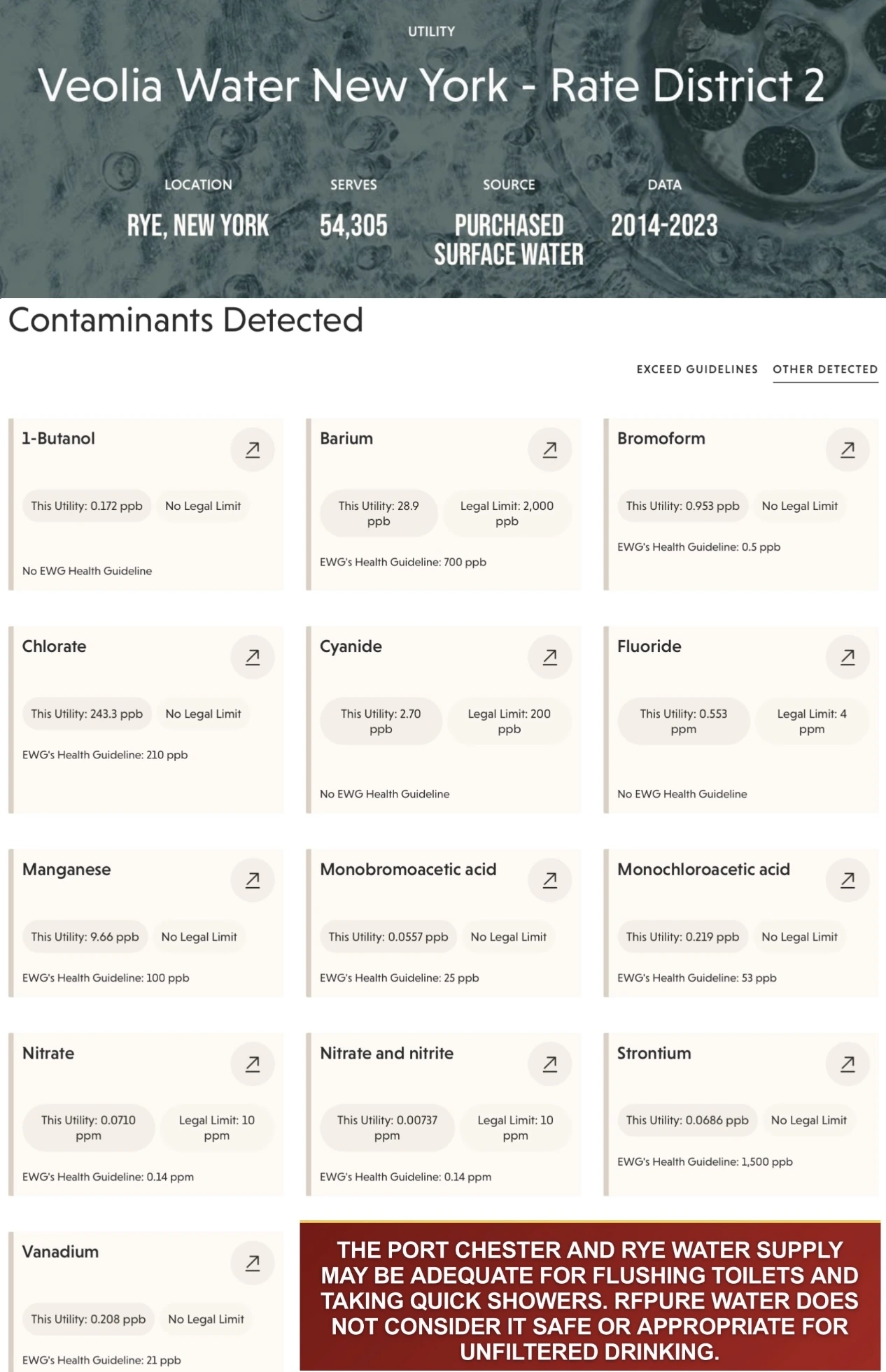
RFPure Water designs whole-house carbon systems and point-of-use reverse osmosis systems around the contaminant class, required contact time, flow rate, pressure, storage and actual household use—not around a generic cartridge sold for every water supply.
Build My Water System